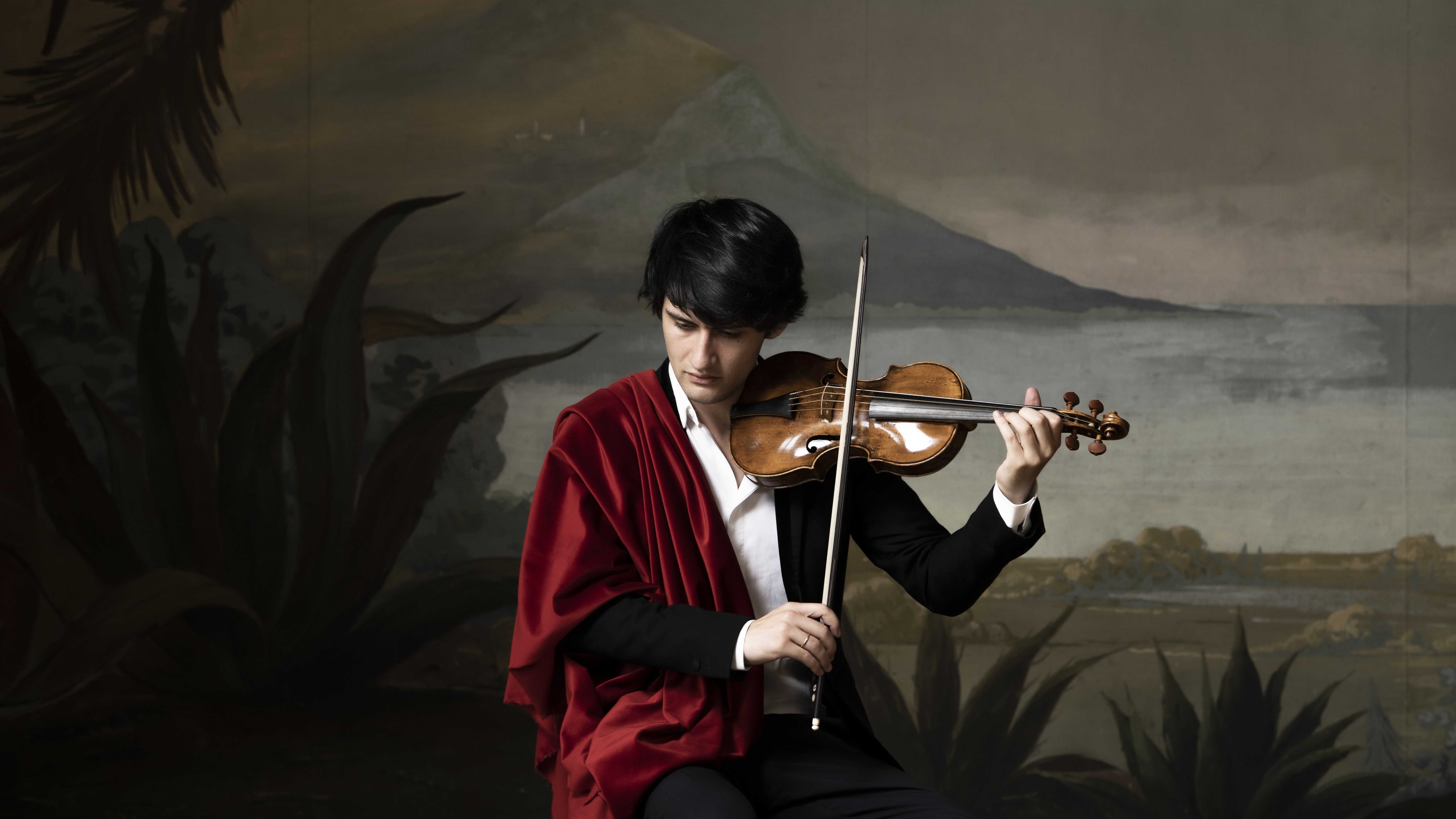
© Julien Benhamou
Article
 Chloe Weiss
Baroque violin star Théotime Langlois de Swarte shares the vision behind his latest album of Vivaldi, including the challenges and rewards of tackling one of classical music's most famous works.
What was your pathway to classical music? Did you have a particularly musical upbringing?
I was born in the South of France and actually both of my parents were singing teachers. My mother conducted a children’s choir, and I used to sing in the choir. I also began the violin at four and the Baroque violin at nine, so that was my musical environment and my inspiration. I did a lot of singing when I was very young, which was very important for my musical training.
You've talked in the past about wanting to emphasise the vocal qualities of the violin. Do you think this connection with the voice at an early age had an influence on your sound?
Yes, when I was young I wanted to be a good singer, but for me it was quite difficult. I think I developed my violin playing because I didn't find my voice as a singer when I was a child. The experience with the choir, and later with my teachers Michaël Hentz and William Christie, really joined together because we all speak the same language of music when it comes to vocality and rhythm. If you find your musical voice, it's really powerful to imitate the singing line. It's so simple to say, "just try to imitate the singing line," but it's so difficult to do. It's a way of thinking about music and trying to evolve in this musical world. I think it's a great goal.
You mentioned two of your mentors, Michaël Hentz andWilliam Christie. How have they influenced you as a musician and helped to shape your career?
I studied at the Paris Conservatoire and met a great teacher, Michaël Hentz, with whom I studied the modern violin. Michaël Hentz was very close to Sergiu Celibidache, the Romanian conductor, and his was very much a school of the sound, of the violin technique and the length of every sound. It's called the phenomenology of music – the science of listening to the sound of music and the results of the resonances – and it's a really magical way of seeing the music. I studied a lot of chamber music with him, and around that time I also met William Christie. Both of their personalities really helped me to build myself musically and to develop my sound, my inspirations and my aesthetic in a certain way. With William Christie it was more about the Baroque rhetoric, the Baroque style, the way to express myself with this incredible and touching repertoire. There was this passion around Baroque and it really taught me so much about interpretation, how to be on stage and how to react. I think his way of doing music is very unique—he has a relationship with music which is very free. I always think that interpretation can be stronger even than the music that we are playing. This is quite a difficult idea normally because the musical text is always the goal in a way. But what’s so powerful with him when he's conducting or playing the harpsichord is that he’s always asking, “What do we want to say? What do we want to say very loudly, and very freely?” It's about exaggeration, it's about emotions, and it's about saying very sincerely, “What do you feel with this music?” This is very powerful when you're on stage with him because you feel that music matters so much. Every note matters as if it’s your life.

Was there a standout moment when you realised that Baroque music was your specialism?
I think sometimes you choose a repertoire and after that the repertoire chooses you. At the beginning I played all repertoire and I even did two recordings of more Romantic music, but somehow I think I speak this language differently. When I play Baroque music, people seem to think that there’s something different that they’ve never heard before, which is why people are always pushing me towards this repertoire. When I play other repertoire, I think it's not so bad, but it's not as unique. So I don’t think there was a precise moment when I decided this, but I began playing with my chamber group Le Consort nine years ago when I was a student at the Paris Conservatoire, and as we started playing more together we also began a career as a chamber music group. I think this was the beginning, as well as playing with Les Arts Florissants, when I realised that Baroque music was my path.
You spoke earlier about drama, which leads me nicely onto the album… Why The Four Seasons?
This work is so important for the violin, for the Baroque period and also for my life in a way, because it was the work I was listening to all the time when I was a teenager. I think it’s thanks to The Four Seasons that I'm now a professional violinist. It's so inspiring and it really captures something of humanity that we can feel even in just ten seconds of an advert. People are always touched by this powerful music because it's very simple in a way, but very convincing, and the message is extremely powerful. I think it was this message that really touched me when I was growing up, listening to it over and over.
The work is reaching its 300th year since publication, and of course there are countless interpretations out there. Did you set out with a vision of how to create your own stamp on the work?
Yes, to begin with I thought about how to do something new with this form. When we play, we play as humans, and human beings are always unique. I think this recording is unique because it's about every player in the orchestra and me, so it will always be different because of the players. This aside, it was very tricky at the beginning to know how to build a recording of the work with other pieces. I wanted to put in perspective all the works of Vivaldi of the same tonality to continue a cycle. There is also a very symbolic Spring, because I wanted this idea of rebirth and resurrection in the album, and that in every dark moment there is always life coming from this very particular moment—it’s a vision of hope. For me it’s not only about the poems of Vivaldi, it's about telling the story of life: in Spring there's birth; after that there’s this apocalyptic Summer with very complex feelings; then comes Autumn with all of this society harassment, the relationship to society and the minorities; and Winter is the story of a dancing dead, or danse macabre. After all of this comes this angel, Julie Roset, singing the Aria Nulla in mundo pax sincera, and suddenly we are in a kind of paradise. She sings and she sees all of the world and says that peace is never free. In peace, there are always the people who died. This is the message. In the wake of this ambiguous message a new season is created; with the new year we begin another cycle with Spring again, with exactly the same season, the same tonality, from different moments in the life of Vivaldi. This is the idea of the project.
It’s really programmatic music at its best. How do you set about trying to illustrate these very concrete, very raw natural images in a sonic environment?
I chose quite a large ensemble for the orchestration—eight and eight violins, so a very big Baroque orchestra. I wanted everyone to play as if it was one per part, so very precise and very accurate to Baroque interpretation. I wanted this accuracy with a large group giving moments of real fortissimo and moments of pianissimo with a lot of high harmonic registers, so that when you have pianissimo everybody plays super pianissimo, but you have sixteen players doing that. I think life in music is always symbolised by consonants and noise. If you think of speaking, you speak with consonants and vowels, and it's the same for violin playing. If you don't use any consonants, there is no nature in the sound. So we talked a lot about noise, about the resonance of the sound and about the way to speak. That was our focus.
Are there any recordings of the work that you’re particularly fond of or that have inspired you?
Yes, my favourite one is of Amandine Beyer, but I don't want to listen to it anymore because I'm so afraid that I will just find mine completely lame! So I haven’t listened to it for years, but I used to love listening to it so much.
And you’re also featuring in a documentary for ARTE about The Four Seasons?
Yes, about The Four Seasons and about this big anniversary marking its first publication. We filmed in four different places in Venice and I went to see the manuscript—not of The Four Seasons because it doesn't exist, but the manuscript of Anna Maria de la Pietà, the main student of Vivaldi. She wrote something like 50 concertos in this very particular book, with every ornament and every cadenza. It was very touching because you have this paper and it was Anna Maria's actual notebook. It was very powerful and special to connect with this tradition of playing.

Do you enjoy directing the ensemble from the violin, in this leadership role? You also directed at the Opéra Comique last year—is conducting something you want to pursue more in the future?
For me it's quite natural when you play this music to conduct from the violin, because it was composed to be played like that. We know that Vivaldi used to play the concertos he was writing himself, so the maestro is always the one who plays the solo. In a way it’s very simple to follow someone leading in this way for this kind of music, but working with singers, choirs and much larger groups is something else, for example Mozart’s Requiem which I just did last week. I'm no Klaus Mäkelä, but I really enjoy conducting as a conductor. I really feel the connection between my life and between the voices. I think I need to work with voices for my happiness, for my mental health. I love it. I began the violin at four, so it's kind of my whole life. It's like asking a tennis player, “Do you sometimes like doing something else?” Conducting is a relationship to pure music, without my violin, so I enjoy this so much.
In terms of your personal listening, does Baroque also feature heavily or do you have other secret (or not-so-secret) passions?
My favourite albums of all time are all of the Beatles’ albums, but I actually don't listen to so much music because I'm working all the time with it—I enjoy listening to podcasts and the radio a lot. When I do, I like listening to my friends' recordings, and recently I've been enjoying Thomas Dunford playing Bach’s Cello Suite on the lute. When I listen to the recordings of William Christie I always get nice information about aesthetic and the interpretation of music. I actually had a really nice experience playing with Ludovico Einaudi on his last album. It was very interesting to see the differences of creation between this way of playing music compared to the classical way. He's very free, and the interesting thing with him is that he feels the music as millions of people will feel it. When he's listening to music, he's not in his own feelings, but he connects himself with some kind of wider feeling, and he really connects with people. It’s quite unbelievable when you're next to him. When I saw this, I had so much respect for this man, because I think it's really difficult to touch people as he does all the time, and really catch something of our times that people need. It’s quite touching.
A final question to end on: The Four Seasons is one of the most frequently performed and recorded works, and it sometimes gets passed off as too mainstream or too overdone. What would you say to the people who have lost the love for this masterpiece?
I would say to anybody who says that The Four Seasons are overdone that they don't know the work well enough to judge. For me, there are two different arguments. One of the most incredible geniuses of all time, Johann Sebastian Bach, used to do a lot of transcriptions of Vivaldi—many for harpsichord. Vivaldi's music is very profound and deep, and in the Venetian practice of music in the Ospedale della Pietà, people were always playing the same music composed for them. I think Bach heard Vivaldi’s music and realised it was something quite unique: unique for the evolution of repertoire and unique for the way to play these concerto programs. If you’re able to inspire Johann Sebastian Bach, then I think this is enough of an argument on its own. But there is also the narrative aspect. The Four Seasons can be so powerful because it tells the story of life. There is violence, devotion, the relationship to God and to the universe. It's really complex music and not as simple as people think. So that would be my answer.
Vivaldi: Le quattro stagioni is out on IDAGIO now.