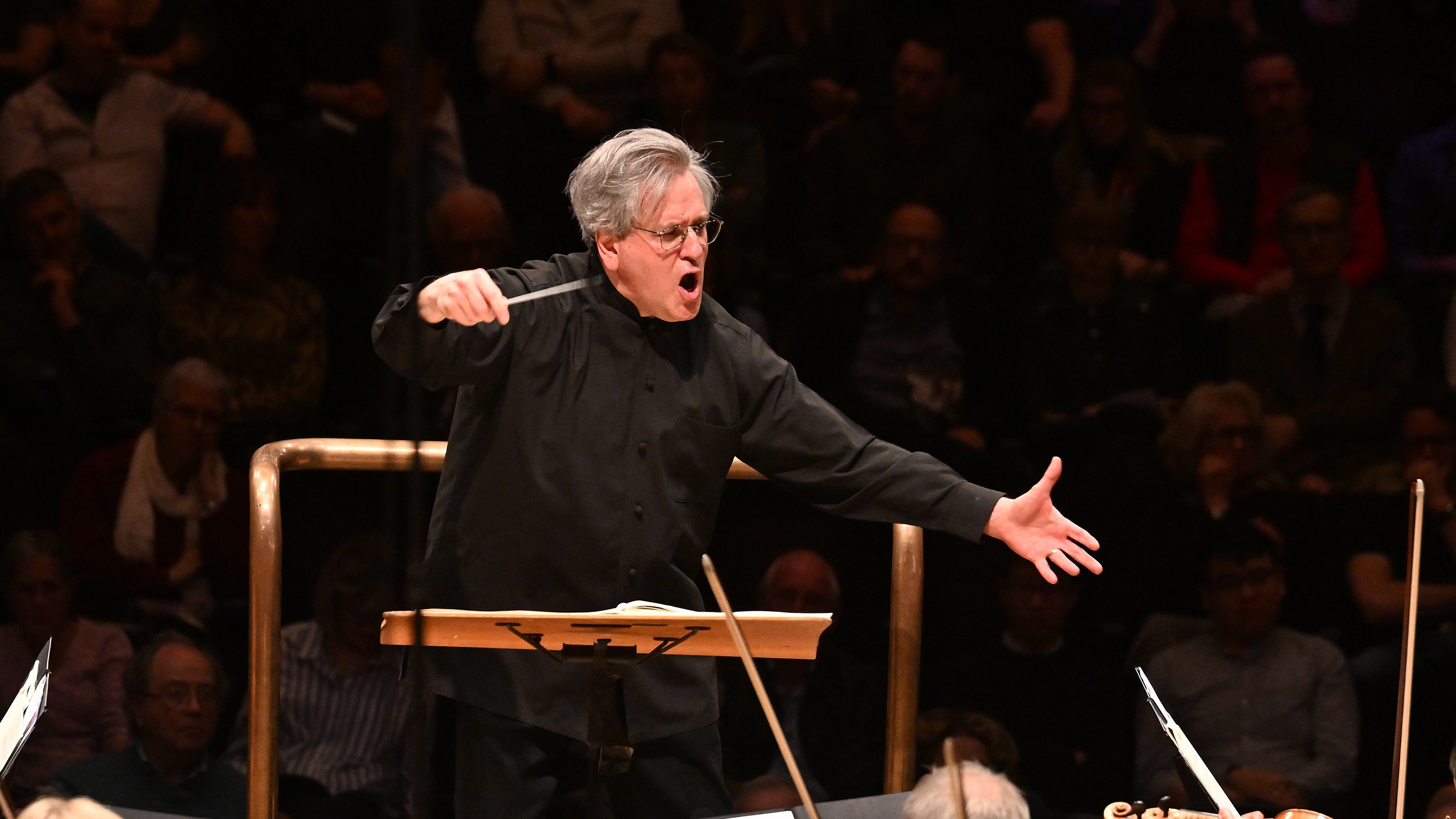
Photo by Mark Allan
IDAGIO Meets
 Nikita Solberg
Esteemed conductor Sir Antonio Pappano shares his insight on conducting, on staying true to the score, and more, in celebration of starting as the new Chief Conductor of the London Symphony Orchestra.
In your LSO introduction, you shared that you want to explore music that you really love. Is there a particular composer, period, or genre you feel especially connected to but haven’t had the opportunity to explore yet?
This season, the focus is on British music, much of which I haven’t conducted before. I want to continue learning and growing. When I performed Vaughan Williams’ fourth and sixth symphonies just before the pandemic, they hit me like a thunderbolt. Most conductors dive into Shostakovich, and I’ve done a fair amount of Shostakovich, but I was struck by how emotional the English symphonies are. Having done Walton’s first Symphony and becoming more aware of Vaughan Williams’ ability to reinvent himself in each symphony, it made me realise how important British music is.
I’m also making connections between British and Scandinavian music. I’ve conducted a lot in Scandinavia, and this season I’m combining James MacMillan’s work with Nielsen’s. The music of the north—its light, its sky, its horizon—is something that fascinates me. My education has also included French repertoire, which I studied growing up, and I’m conducting more of that. Last season, we performed and recorded the complete ballet of Daphnis et Chloé, which will be released next year. American music is also important to me, as I grew up in America.
There’s a reason behind all of this. It’s about exploring music that I’m passionate about with the LSO. As we go on, Bruckner and Mahler will be preoccupations, but for now, I’m focused on this mix of British, Scandinavian, and French music. Opera will also remain essential, and I plan to do more operas in concert form with the LSO, something they’ve historically done very well.
Would you say it's challenging to keep the momentum going through long tours, like your time at the Salzburg Festival or extended runs at the opera?
Well, it depends on the heat– we've got global warming. Somehow I think all of us conductors are sweating much more than we used to. I think a run of performances, whether on a big tour or in the theatre, is an opportunity. Each performance is equally important for every person who pays to come to a concert or an opera performance. The second performance, the third, the fourth, or even the seventh, it’s all the same. I have a very strong moral code: if people pay for a ticket, you have to deliver something that is worth paying for. That's a rule of show business that's sacrosanct.
Music and musicians, given the chance to mature, ease up and become more familiar with the material. It’s a golden opportunity to develop a Selbstverständnis with the repertoire, which is a beautiful thing to be part of. If you're playing a new or underplayed piece, the opportunity for that piece to be repeated and heard in more than one place is fantastic. That doesn’t happen often because promoters might be anxious about having too much modern music on a program, or any at all. Strangely, people are still sceptical about modern music. You put Schoenberg’s name on a program, and your ticket sales will drop. Unfortunately, that’s just what happens.
But it is a golden opportunity for a new composer to get their music heard. The LSO has been very fortunate to bring programs that include a bit of everything: a bit of our English compositional heritage, something that allows soloists to express themselves, whether it's Chopin, Rachmaninoff, Sibelius, or Elgar.
I am polyglot; I am of Anglo-Italian-American background, and I’ve worked a lot in Scandinavia. I speak German, French, and Italian, and I’ve been in the opera house all my life. So, I have a wide range of interests. The LSO can do anything and everything. It’s a fantastic opportunity for us to tour and put our message across, making a visceral impact on the audiences we perform for.
The LSO is one of the most visible orchestras, not just from recordings but also through social media, so it’s exciting that sharing a diverse range of music is a priority for you. As we approach the typical retirement age in other professions, what do you do to stay inspired and continue growing as a musician and conductor?
In the last six to eight months, I’ve taken on a personal trainer, just to keep myself more physically aware. I’m not getting any younger, and that has been eye-opening. It’s been really important for me. The rhythm of the LSO is something completely different from the opera house or even my symphonic experience in Rome. In Rome, we did three concerts of the same program in a week and then moved on to the next. Here, in a week and a half, I might do three different programs and then take them on a long, arduous tour. The rhythm is much faster. I have to be much more nimble with the repertoire and preparation.
On tour, you need to put your best foot forward and show your best side. You have to always be on point because you’re being invited to perform alongside all the great orchestras. I think that’s what has kept the LSO in the top echelon for many years—there’s an incentive to always be at your best.
The way I look at it, you’re only as good as your last performance. You work hard, and you have to think long-term about your career.
Quick question—do you listen to classical music while working out?
No, I don’t listen to any music while working out, and I’ll tell you why. When I have a session with my trainer, it’s an hour where I can get away from music and think of completely different things. Of course, when I’m working on my arms and shoulders, I’m aware of what my body does during a concert or rehearsal, but it’s that break from music, that concentration on something else, that I find refreshing. We all need a distraction.
With technological advancements, how do you see the role of the conductor evolving in the future?
There’s no question that every arts institution has to embrace technology. It’s taken the world by storm, and quickly. But these things are tools. You embrace them because they help you get your message across in different ways, whether it’s through aesthetics, filmmaking, or educational videos around the works you’re performing.
For instance, the 360° camera that allows people to “live” inside the orchestra is quite something. Sure, it might seem like a gimmick, but it has a “wow” factor, and that’s valuable. What interests me is the greater ability to tell stories using these tools.
If I can talk into a camera while I have the orchestra there, and I can talk about the music I love, and share that with the orchestra, to say, “listen to this and listen to that,” and have cameras from the side and from above— you can create something that is visually interesting, and can invest in a cutting and editing process that makes it engaging, especially for the young viewer who wants that. All the while never dumbing down the product. I think technology is a wonderful thing. Big screens in outdoor concerts are great.
Music requires physical and mental effort. But of course, audiences are sitting back in a lot of halls, and there's a certain distance created. In some halls, there's an embracing of the performance, and in those places that don't have that embracing factor, I think it's important to maybe see what's going on in the orchestra, because I think it's very telling—the amount of physical effort. And I think you hear the music in a different way, understanding what it takes to produce sound energy. Energy is a fantastic thing. We have bags of it, and we want to share that.
Music is nothing—just dots on a page—until you put energy behind it. And so, if technology can help us with that, then yeah, bring it on.

Curious to learn more about your relationship with physical versus digital media—physical ownership versus subscription services like IDAGIO. How does music streaming fit into the industry? Do you think it makes music more accessible?
I do have a wall of CDs at home—much to the chagrin of my long-suffering wife, Pamela. Look– I haven’t bought a Kindle yet. I need a book in my hand. The CD, the physical product, is very important to me. But I have to be honest: when I want to listen to something, more often than not, I go to some kind of streaming outlet. Physical ownership is something else—it means something else. It's like bookshelves; I can’t live without them. They represent my history—the books I’ve read and the books I wish I had read. You know what I mean?
So I’m thrilled that for relatively little money, you can have a vast library of recordings at your disposal. These are also teaching tools. If you know where to aim for yourself, but you don’t have the time to listen to all the recordings, you can scroll through and find what's there. There are triggers for your brain, and that’s always positive—the fact that you have recordings from far back in history to totally up-to-date ones. It’s very valuable to plot the history of performance, and that’s very, very important.
Speaking of recordings, with your upcoming release of Mendelssohn’s "Elijah," and working between the choir and the soloists—ensuring that there's a connection, how does that work when you're doing a recording project?
Elijah was recorded live, performing in front of an audience. It’s a very dramatic piece of music, very close to opera. The declamatory nature, both for the soloists—especially for Elijah himself—and for the chorus, and the thrill of the drama and symphonic moments are overwhelming. The slow movements in the score are some of the best ever written. As an opera conductor, I'm very attracted to this work because of its narration, powerful story and characters, especially the dignity and insecurity of Elijah. And ultimately the ability to win over the sceptical and spoiled people of Israel of the time and bring them back to God—it’s a wonderful story. It's biblical, and it speaks to us today about the challenges of society.
But all that to say, I'm about narration, I'm about storytelling, and I want the orchestra to be as vivid as possible from the overture onwards, to give as good as it gets from the chorus, and to react dramatically and theatrically. This is a work that certainly inspired Richard Wagner. If you know Wagner, you know he was inspired by this work, despite everything he said in contrary to a composer like Mendelssohn. I'm thrilled to be able perform it in English as it was premiered here in England. The first performance was given in Birmingham. I’ve always performed it in German, but it was written in German, after all. However, it's a point of honour that we had the premiere, so we decided to do it in English.
Did recording it in English feel like you had an extra ownership of the piece, since it was first performed in England?
Yes, but the Victorian English of the time is often awkward to our ears today. So, my singers and I made some changes here and there—nothing huge, but people familiar with the English version will notice some tweaks we made to get closer to the syntax of the German, to get the accents in the right place. At the end of the day, Mendelssohn was a German composer, and if we can align the accents to where they are in German, that’s what we were aiming for. It’s not always possible, but I think we've done the piece a favour.
In Mahler’s time, it was common for conductors to reorchestrate and rearrange operas and symphonies. Do you think the score is sacred, or are you open to reorchestration?
The score is sacred in terms of one’s study of all its facets. We all have difference capacities. You have to treat the score as the Bible. But there is also a practical side—a reality. There's the acoustic of the hall, the language you’re performing in. How does that change the tempi, or the gradation of dynamics? You have to remain inspiring—fight for the text, but not be imprisoned by it. Certainly, with translation, you have greater freedom. The hope is always greater communication—not because we're smarter or know better, but to ensure the text is clear so the audience doesn’t have to strain to understand.
Is there anything else you’d like our readers to know?
We have so many recordings coming out in the future and we’ll continue to supplement our Vaughan Williams cycle. It’s a very exciting time, and I’m thrilled about it all.
Mendelssohn: Elijah is out on IDAGIO now.