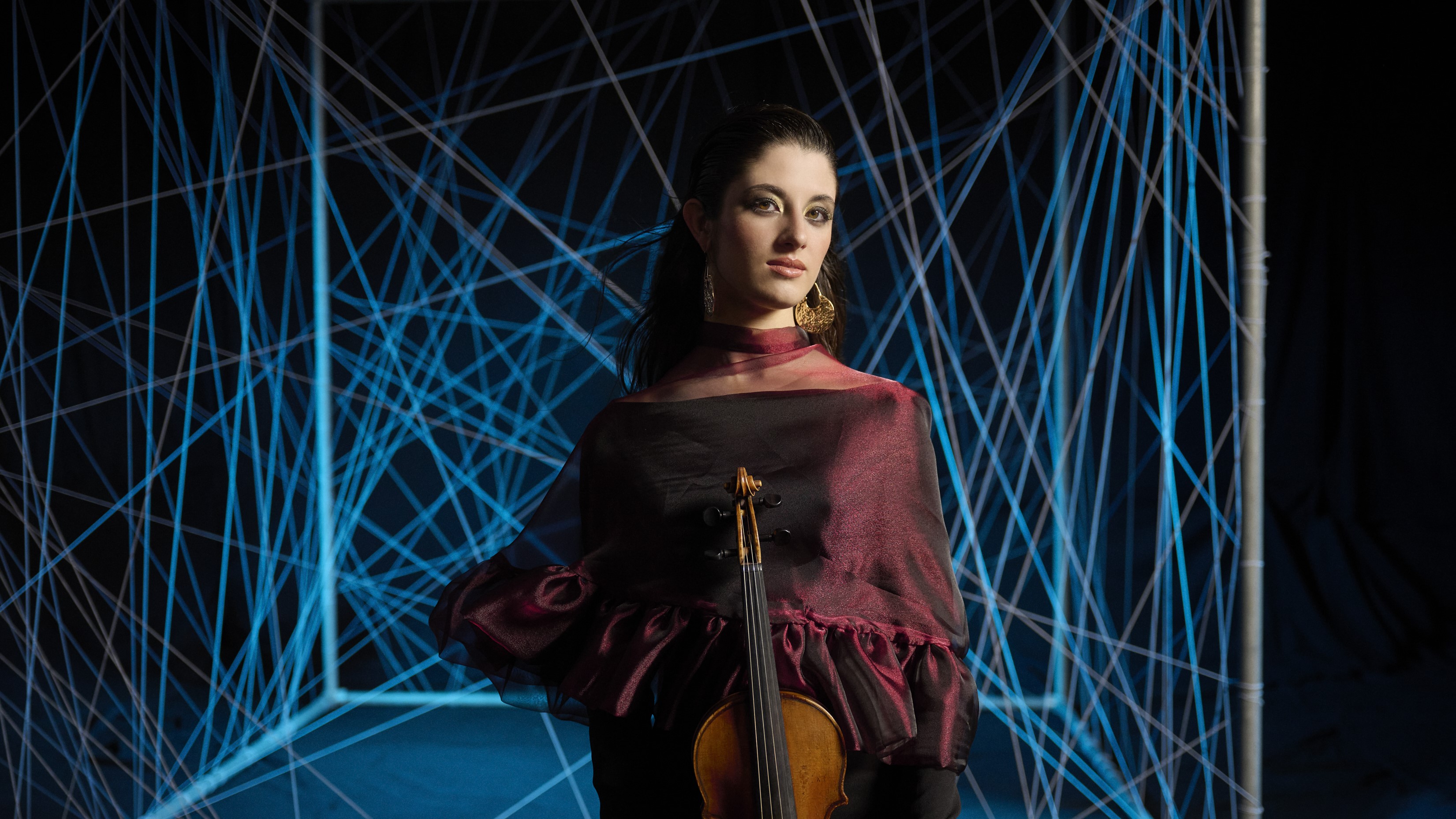
© Sonja Mueller
Article
 Chloe Weiss
Spanish violinist María Dueñas, one of classical music's rising stars, talks to IDAGIO about her latest album on which she tackles one of the most demanding works ever written for the violin, Paganini’s legendary 24 Caprices.
In terms of your recording career, it was straight in at the deep end, signing with Deutsche Grammophon in 2022 when you were just twenty. How did you feel when you got that offer?
It was very exciting, also because I had very clear ideas of what I wanted to record – I wanted to do the Beethoven Violin Concerto for my first album – so I was very grateful that they really accepted this with open arms, and I was really happy with how we worked together. It’s a very organic kind of relationship.
What was the reason for wanting to record the Beethoven first, and in general how do you go about choosing the repertoire for your albums?
The Beethoven concerto always played a very important part in my career in many ways. It helped my understanding of myself as a musician, and with the cadenzas I felt like I could give a lot of my personality through these works. It was important to me to have a very personal first recording. Even with the second album, centred around Paganini’s 24 Caprices, it was very important to have some kind of personal motive for the work, and of course I grew up playing the Paganini caprices. Beethoven and Paganini have played such a big role in my career.
Paganini wrote the 24 Caprices as technical studies and exercises. What was your approach to the work in terms of interpretation?
At the beginning, like for every other violinist, they were a way of improving some technical aspects of my playing, and I played a lot of the caprices at competitions and as encores after concertos. For me it wasn’t just the technical side that was interesting, but also the ideas behind them. I read so many times that Paganini wrote them for himself and for his friends, maybe to work on certain elements. It took him more than fifteen years to finish the set, and I think it’s very interesting to see this evolution of his life, with lots happening, developing and growing. I like to think that every caprice is like a little step in his life and to work with this evolution in my head. Of course the technical element is the key point at the centre, but there’s also the musical aspect—I was also fascinated by the vocal quality in the caprices and the inspiration of bel canto opera. Nowadays you don’t play them only for yourself, you play them for an audience, and I think that there has to be something more than just the technical aspect, because in the end you communicate to the audience with the music. So I think that was my personal challenge and goal for the recording: to really highlight the musicality of the work.
I like the idea of these steps, because each caprice really has its own character and story. Would you be able to pick a favourite, or one that means the most to you?
Of course No. 24 is the most famous one, so that was a very fun caprice to work on. I also have a very special relationship with No. 5 because it’s the one that I’ve played the most and for which I experimented so much with bowings and other technical aspects. From a musical side I would probably say that No. 11 is one of my favourites, because musically it’s just so beautiful, and I also love this middle section where it gets quite wild.

This album is really a celebration of the caprice. How did you bring these works together?
When I talk about caprices everyone always thinks about Paganini – at least in the violin world – but there are so many more. There are so many other caprices that have this kind of improvised or caprichoso element that unites them all. I had some very clear ideas, for instance Jordi Cervelló is a Spanish composer who inspired me so much. He died recently unfortunately, but we had a really good relationship so I wanted to include him. Then there was the Introduction & Rondo capriccioso by Camille Saint-Saëns which I practically grew up with, hearing Jascha Heifetz’s recording. I also wanted to show some lesser-known pieces like the Caprice andalous, also by Saint-Saëns, and the Rêverie & Caprice by Hector Berlioz, both of which are very rarely played and were also a great discovery for myself—I didn’t know them either. I always try to incorporate contemporary music into my programme because I think it’s a way of inviting a broader audience to the concert hall, so it was very interesting to commission Gabriela Ortiz with a capriccio as well, to show the many different ways the capriccio could be composed or played. That was my idea for the album. It’s a small selection, but I tried to show a bit of every world.
You mentioned Jordi Cervelló and there’s also a Spanish connection with the Caprice andalous by Saint-Saëns. How important is your cultural heritage in your creative output?
It is, for sure, and since Saint-Saëns was also inspired by Pablo de Sarasate I see a lot of Spanish flavours in both his pieces. With Jordi Cervelló, he was always a very free-spirited person, so it goes really well with this word capriccio which gives a sense of fantasising and improvising. It was really the perfect piece to show a part of my country, which is not always so easy.
You’ve also worked a lot with GRAMMY® Award-winning composer Gabriela Ortiz, who dedicated a concerto to you, and this album features a world premiere recording of one of her works. Could you talk a bit about your collaboration with Gabriela?
I’m really lucky because Gabriela is a wonderful composer and she’s also very open to my ideas and what I have to offer, so of course it’s a very interesting process and you kind of create the piece together. When she first heard me play her score she said it sounded almost like another piece, because she told me I give so much of myself as well. I think this is very important because you never know how Beethoven wanted his concerto to be played, for example, but in this case you can actually talk to the composer. She was telling me about the story and thoughts behind the piece, which I enjoyed very much.
You’re also a talented composer, writing your own cadenzas for your debut album in 2023 featuring Beethoven’s Violin Concerto. How did you get into composing?
Well I never really studied composition, I just started with the cadenzas because already as a small girl I thought that it's such an exciting opportunity if the composer gives you the chance to write a cadenza. It gives you a chance to show another side of your professionalism, and it’s also very interesting in the sense that you get much deeper into the music. For instance, when I was writing the Beethoven cadenzas I was working with the manuscript and seeing all the changes that Beethoven made to the concerto, and I really analysed the music on a much deeper level. That was actually the first thing I composed. It seemed very natural—I didn’t really think so much about it.
One of your compositions, “Farewell” – composed when you were just thirteen! – was awarded the Robert Schumann International Piano Competition award in 2016. Is composition something you’d like to develop more in the future?
It's funny because the little piece I wrote for that competition was only one or two minutes long, because that was the requirement, and then it was probably five or six years after that when I actually composed the second part to that piece, which is the one that's now on YouTube. It was just a good way for me to put on paper what was going through my mind. Right now I just do it when I need to or when I want to. I don’t feel any kind of pressure to do it.
What are your musical interests outside of classical music?
I like listening to pop music, especially the older generations, like Whitney Houston, Aretha Franklin or Celine Dion. I feel like they have a really recognisable voice, which is also what I’m working on in my music, so it’s the biggest inspiration.

You already have a busy career and heavy tour schedule for someone your age. How do you feel about being on the road, and is it hard to come back and focus on your studies?
Well I try to combine both. The good thing about studying music and violin is that I have a lot of freedom in what to choose and how to organise myself, so I take a lot of subjects whenever I'm home and everything else I just do on the road.
Is it easy to maintain a work/life balance?
I like to maintain a quality in my playing so it’s important to have time to really practise and think about the music – about everything – but I also like to have a balance where I get to come home and relax, also for my body to recharge in a way. So yes, for now I'm very conscious about this kind of balanced life.
You’re so experienced on the stage and in competitions—are nerves ever an issue for you, or have they been in the past?
I think everyone has nerves. I try to see them in a positive way because I know that nerves will be there, but that's a good thing because it means that your body knows that something exciting is about to happen. It's not just some kind of routine or some normal day. So I've kind of integrated them in a positive way in my playing. I learnt to adjust to every kind of possibility happening on stage. When I was younger I didn’t get that nervous—it felt more like excitement. Of course nerves will be there and it can affect your playing, but I think it’s about learning how to control them, for instance knowing what to do with your body in order to fight against it. I think that's the most important thing, but also really practising at it by playing for friends or putting yourself in a nervous situation before playing the actual concert.
As a young person yourself, what do you think is key in drawing a younger audience to classical music?
We should use all the ways that we have to present music to younger audiences. It could be through social media but also promoting music more at school level. What I'm also trying to do is to discover new repertoire, because of course people know all the classic pieces, the biggest concertos, but I think there are so many lesser-known pieces that have never been played, and I think getting people interested in other kinds of repertoire might open the scene of classical music a bit. I'm always very happy whenever young people come to my concerts because it’s not so usual to have a career or find your way in classical music if you don’t come from a musical family, like in my case, so I'm hoping it will inspire other people to get into it.
Have you got a focus in terms of what you really want from your playing at the moment or something you’re working on with your mentors?
Yes, this question of really having your own sound, a very honest sound. I try to play how I really feel and to not get influenced too much by other recordings. When I was growing up I could always tell if I was listening to Heifetz or Oistrakh; they have that unique voice which I feel has a specific meaning nowadays. I think that’s the only way I can give a little personality to the immense world of recordings we have already.
Which future projects are you most excited by?
There are a lot! I’ll be working with some great artists who mean so much to me, for example Gustavo Dudamel. I like to present concertos that are not played very often, so I’ll play a lot of Saint-Saëns concertos this season and also the Korngold Violin Concerto, which I’m really excited about. I also have some great tours coming up with the Chamber Orchestra of Europe and Sir Antonio Pappano, with whom I’ve never worked before. Every concert is very special to me.
Paganini: 24 Caprices is out on IDAGIO now.