©Kaupo Kikkas
Article
 Nikita Solberg
Ahead of Arvo Pärt’s 90th birthday celebrations, IDAGIO spoke with conductor Paavo Järvi about his latest recording project: an album dedicated to Pärt’s music, recorded just this summer at the Pärnu Music Festival. Järvi shares insights into the recording process, personal memories of growing up with Pärt, and his advice for listeners on discovering new music.
Beyond Credo, how did you decide which works to record for the album?
Except for Credo and Cantus in Memoriam Benjamin Britten, this album contains works that I’ve often conducted, but most of which I have never recorded. This includes Silhouette, a world premiere recording of a work that Arvo Pärt wrote for me when I was Music Director of the Orchestre de Paris in 2010.
For this special album tribute, I wanted to include compositions that documented his entire compositional process. Credo represents Arvo’s first, avant-garde period and that made him into a dissident. Later, in his second period, he became really famous with his Tintinnabuli style, with works like Fratres. But then there is a third period, spanning the last ten to fifteen years, that he doesn't quite officially acknowledge and in which he writes in more of a romantic way. This music has the same principles as the Tintinnabuli style, but its sound world is more overtly expressive, which is felt in works such as La Sindone and Swansong.
This album features works that I really like personally. Für Lennart in memoriam is a very beautiful and moving piece, commissioned by our first President after the new Independence in Estonia. When the President knew that he had a terminal illness, he asked Arvo to write him a piece for his funeral.

In regards to commissioning Silhouette from Arvo, what guidance did you give him?
Only the subjects that really interest Arvo get the chance of becoming a piece and, when he writes, it is always on his own terms, never from specifications of the performer. I asked if he might compose a piece that I could premiere with the Orchestre de Paris, knowing that it would be really special, but he replied that he wasn’t interested and simply didn’t have the time.
However, a few months later he invited me to his house. I had previously asked if there was anything about France that could inspire him, such as its culture, history, art or something specifically about Paris. He wasn't sure. But when I visited, he had a very thick book all about the Eiffel Tower. All the blueprints, the letters, correspondence, pictures, the mechanical drawings, the financial papers, all published in this incredibly comprehensive book.
Arvo was obviously excited and presented his piece. He went through the score page by page, highlighting aspects about the Eiffel Tower, such as its structure which makes metallic noises when the wind blows. All tall buildings sway but as the tower has no walls, the effect of the wind is that much stronger, especially on the higher levels where you are up amongst the clouds. Sometimes you can only imagine what you see. At other times you can just see a silhouette, hence the name for the work.
Once a composer describes something like this, it's incredibly clear how to perform it and what the intentions are. People always assume that every piece by Arvo has to be treated as a religious experience. It's not the case. It’s possible that similar gestures can be used to describe other events. I must say that now recording and playing it again, I really rediscovered the piece. I have been listening to the playbacks and from everything that we recorded it's a favourite. It's so original and atmospheric at the same time.
You mentioned Arvo entertaining a sort of third period of composing style right now. Following the clear distinction between the first and second periods, can you share any insight to the third?
I don't think that even he would call it a third period. I think that he sees it as a development or continuation of his Tintinnabuli style, that has become so recognisable. But as a performer and somebody who has known his music all my life, it’s how I see it. I have performed his music since my very first professional concert in 1985 in Trondheim, Norway, when I conducted his First Symphony. His music has since become more open and romantic. It was always very human but on top of everything else, there is a certain warmth that I find in his later pieces.
In the album booklet you shared that you grew up with Arvo as a friend of your father’s; is there a story or experience that maybe people would be surprised to know?
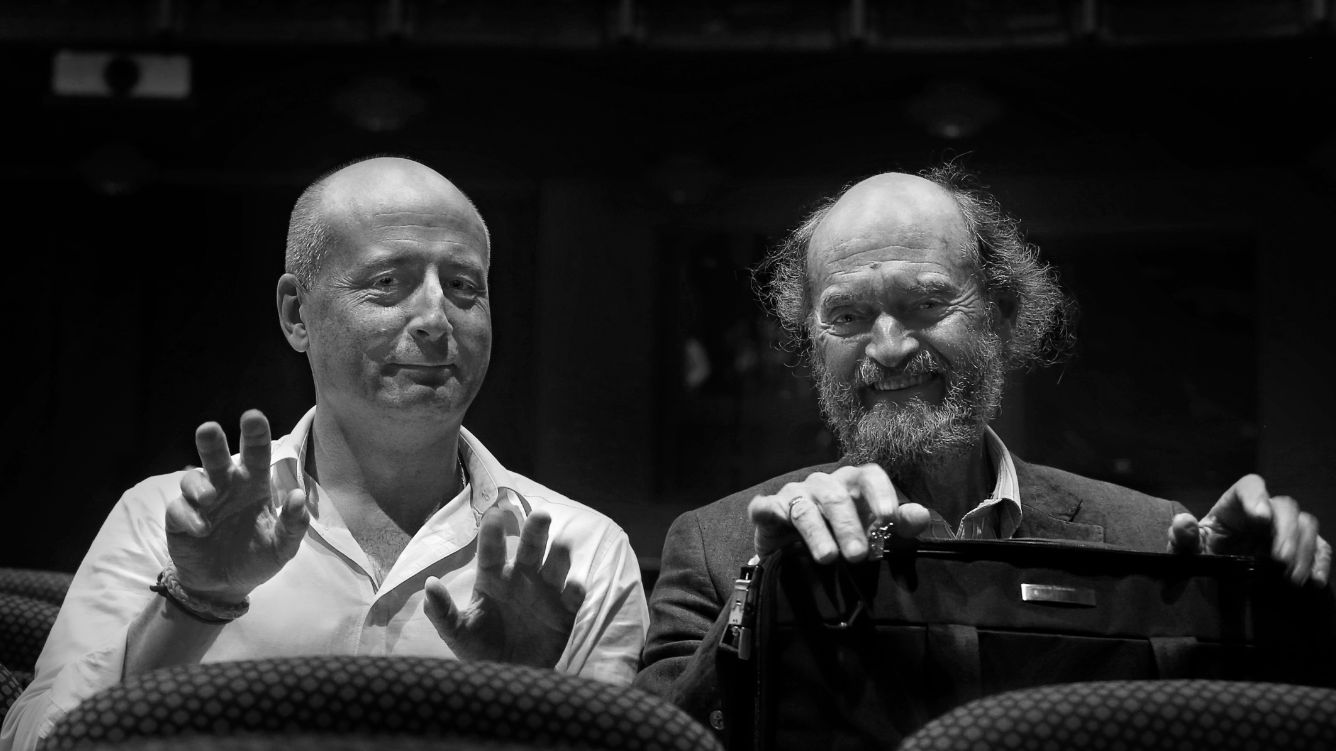
I am always surprised when I hear people describe this monk-like figure who is totally devoted to composing and serving God through his music. On some level that is totally correct. But what people don't know about him is that he is a very warm human being. He has a great sense of humour and you can't help but notice how much people love him. This image that most people have of him with his big beard somehow feels funny to me because I know he always has the spark in his eye and always looks for a potential joke in any sentence.
Are there any lesser-known works of Arvo’s that you believe deserve more attention?
Depending on what instrument you play or what area of music you're in, you are automatically drawn to the pieces that use the same instrumentation. As an orchestra conductor, I gravitate towards the early works when he wrote his symphonies. They were very experimental and sometimes full of protest and double meanings to show the reality of the society in which he lived in the Soviet Union.
One of the first pieces he wrote was called Nekrolog, and a Nekrolog is what you publish when somebody dies. Imagine a young composer writing his first piece and naming it the Nekrolog as an obituary to the political system in which he lives. Immediately he risked going into a direct confrontation with authorities which was not a good idea. His early pieces are scored for large symphony orchestra, but in his more introverted choral music he used a smaller orchestra, and often just the strings. Whilst there are many gems and great pieces, I would encourage people to look into his early period and the symphonic works.

With Da Pacem Domine there are a number of editions and various instrumentations suggested, how did you choose which to use for this album?
Da Pacem Domine was first written for choir and while there are other versions of it, the one that made the most sense to us was the string orchestra version. It later became famous because of the Madrid bombings. Generally most of the pieces that he has written in his second period have more than one version. This practice is a medieval one where you write music and then various groups can adapt it for their needs. So it's not a new thing, in fact quite the opposite.
Did you rediscover anything new about the works while recording?
Recording Silhouette this summer spoke to me in a much more visual way. The first time I performed it was without Arvo present and since then, the piece has had many transformations and orchestration changes. Recording this work was a rediscovery, especially after recording pieces like the Cantus and Fratres, which are so well known. These works always strike you since they’re deservedly regarded as masterpieces. You can naturally see why they’re famous. It's obvious that there is a certain depth and quality to the pieces that you just immediately recognise.
Für Lennart in memoriam is a piece that I love and that has a very deep and immediate sound. It'll never become a big hit like Cantus or Fratres because it's more introverted, but it has warmth and a narrative. Maybe it also has to do with the fact that I knew the person it was written for and the personal message it contains.
Another work I found very interesting is Mein Weg, which has a very precise ticking rhythm that runs throughout the piece, without ever changing. But what's interesting is that it is the only piece on the album that has a clear rhythmical skeleton, a very unusual rhythmic ostinato.
It’s interesting that you said that it's constant throughout, because when we walk, we don’t always walk consistently at the same tempo. You can walk faster, you can walk slower.
But it is that kind of consistent inevitability that comes into play. There are probably many aspects of Pärt’s works that are private, but with this piece, in which the clock ticks relentlessly without looking back or stopping? It is just something that keeps going and we need to simply accept it and live with it.

What else can you share about the recording process? It took place at the Pärnu Music Festival in Estonia?
This is the fifteenth year of the festival and luckily it coincided with Arvo’s 90th birthday. We took the opportunity to perform and record the album and all the performances were filmed, so we have both an important audio and video archive of the event. Recording live is a very special and risky process but it adds a certain amount of spirit to the pieces when the audience is present.
For Credo we used three enormous choirs as the piece has to be really overwhelming at its climax. The music is very allegorical and juxtaposes goodness and honesty against the dishonest and ugliness of the world. This is something that comes across so clearly in the work. Many in the audience at this year’s festival had never heard the work before because they're too young and 1968 is a long time ago.
It was unbelievable to see their reaction and to realise how much impact the work still has. Some of the pieces of the avant-garde period of the 60s and 70s can sound dated and don't quite have the same effect. With Credo it doesn't sound dated and it’s still shocking.
What are some aspects of Estonian culture that you think people be would be most interested in?
The Estonian paradox is that we are very small with a population of less than one and a half million people. It is very telling that a nation so small can be so powerful on a global scale, despite its size. You must ask, what actually makes that identity strong and what is so particular about the language?
One realises very simply that if the language is gone then your identity is pretty much wiped out. Estonia has remained Estonia through 700 years of wars. Other countries are constantly interested in this part of the world because of its border to the sea and so it is a country that was so often taken over by others.
What matters is having a strong language and music. When a language is preserved, it is very often not just through reading but also singing. The first words that you usually hear in your own language are from your mother singing lullabies, not from books. Singing has been incredibly important for us in the last revolution. After the Soviet takeover, it was called the Singing Revolution when everybody held hands and sang national songs. It was a peaceful but incredibly strong manifestation of unity and we still have these big song festivals.
The other paradox is that there is probably no other country in the world where the most famous person is a classical composer. For any other country, you have a lot of choices because the population is so much greater. We have a classical composer with an enormous following. A similar example could be Iceland where the most famous person is a pop singer, Björk, but that's about it. As a result we have a lot of musicians and younger people involved in classical music. When you go to a concert in Estonia, you'll see a young audience and hear a lot of new music, since there are many composers in our small country, who are so internationally well-known and respected.
Our Pärnu Music Festival has gone from strength to strength. All the concerts are sold out and luckily we can regularly premiere new music. It's something you couldn't do anywhere else. New music here is integrated and the composers are kind of celebrities. Recently we had two young female composers on the covers of magazines and newspapers. This is unprecedented. For a composer to get a front page of anything is unheard of, unless they have died or something major has happened in their lives.
With founding the Estonian Festival Orchestra, the Pärnu Music Festival, your time with the Deutsche Kammerphilharmonie Bremen, you haven’t followed the most traditional path in a conducting career. What advice would you give to those hoping to create their own opportunities?
Everybody's road is different. I don't think that one can really give advice to individuals. Everyone has to feel their own way and find the path that is right for them. Sometimes this path is not even something that you feel is right at the time and sometimes it seems to be the only way – you might not even have a choice to turn it down.
Or sometimes you get lucky and then the question is how well you are prepared. In today's world there will probably be one or two moments in everybody's life where they get a chance. Very often what happens then is that people are not ready. The preparation has to be very strong.
There’s the saying, luck is where preparation meets opportunity or chance. Some people are lucky but they also have prepared to be able to show off in that chance.
That is the most important ingredient, because I feel that everybody will get at least one chance. I see a lot of young conductors who get chances now that some of the great conductors of the past could only have dreamed of. Living up to it and being invited back depends on your preparation. It’s not likely that every young artist is able to impress a great orchestra because they have simply not had enough experience. But occasionally there are those that not only live up to the expectations but exceed them, and they are the ones that become the future generation of leaders.
In my case I was very lucky because I was born into a conductor's family. We have three conductors in the family plus countless musicians, so it's never been a question of thinking about what I should do. It was only the question of can you do it? Are you good enough? Do you want it enough? Is it something that you're prepared to do for the rest of your life?
At least for me, it was never even a question. It was yes to all of this. Absolutely, I want to do this.
I’m very grateful to the people who have opened a door for me and to the many people who have helped me along the way in various capacities. It is now not only my duty but also a privilege to open the doors for others. The Pärnu Music Festival was created with exactly that idea: to help young musicians.
We create networks by inviting top musicians from around the world, giving young people an immediate opportunity to meet and collaborate with colleagues at a very high level. It impacts their way of thinking, and improves their self-confidence. So much is accomplished by putting the right people next to each other and creating contacts. The goal of this festival is that, by the time a person leaves, they have a phone full of new friends’ numbers. Not just personal friends or musical friends, but connections who potentially support for life.

Speaking of preparation, it can be easy to only listen to the music you’re immediately preparing for. But do you have any works on your playlists right now that you have been exploring on your own?
My playlists are so strange that if anybody would listen, they would think that they don’t know me. I never listen to normal repertoire. I only listen to things I don't know. I want to know elusive music and learn why it is played so seldom. The repertoire is so enormous and so vast that one lifetime is certainly not enough to perform it all.
Even if I'm not going to conduct these works, I need to listen and be curious about them. Maybe there is something interesting in what I have missed. With the works of well-known composers like Bach or Brahms, I don’t listen to them. I love them but I don’t listen to them.
When performing on the highest level you must be incredibly well researched and that takes a lot of time. When somebody has a small repertoire, it’s still amazing how deeply they can get into it. Others can conduct a lot of things and they do everything badly. Nobody thinks that Carlos Kleiber wasn't a good conductor because he had just a handful of pieces that he wanted to conduct. It only matters how well you do it and what you bring to those pieces. It can be very subjective.
Bach is the number one listened-to composer at IDAGIO. However our goal is also to encourage listeners to explore. A lot of people do turn to music for comfort but there's so much under-discovered music.
Here’s my advice: listen to a lot of different types of music but also listen to the whole work. The mistake that's made very often is that somebody listens to a little bit and turns it off. If you listen from the beginning to the end, you have a bigger picture. And sometimes at the very end, things start making sense.
Sometimes it’s challenging to discover what music you think is actually good if you’re always told which are the best works. When you listen to music you’re not familiar with, you can form a connection to it without depending on the opinions of others. It can be a very personal experience.
Exactly. If somebody says you have to listen to this, this is great, sometimes you need context in order to understand why it's so special. You must always be listening and remain constantly curious about music. You should not only listen to the works that you need to prepare for something, but it should be part of your every day. It should be listened to at home.
If you listen to music at home as a parent, your kids will grow up thinking it is normal. If you only listen to pop music and the kids never hear anything else, then when they are twenty and at their first orchestra concert, they feel they can’t connect with it. It's totally understandable. A lot of what can be improved nowadays can be changed by listening to many types of music at home from a very early age. This is how I grew up.
Can you share a little about some of your passion projects coming up?
My main musical focus now is with the Tonhalle-Orchester Zürich and our ongoing Mahler cycle. And of course the Haydn London Symphonies with The Deutsche Kammerphilharmonie Bremen. I’ve just now embarked on a Schubert cycle as well which actually has been my dream for years. Exploring Schubert’s symphonies is something I've been enormously looking forward to.
With the Estonian Festival Orchestra we will have a concert in Carnegie Hall in the fall alongside a tour in Europe. We're performing an all-Arvo Pärt programme. I was very curious about the reactions of some of the younger kids but many find these new pieces really cool, when sometimes the genre is considered unlistenable and hard to connect with. We're lucky to be able to share modern music with audiences that really go for it.
Paavo Järvi and the Estonian Festival Orchestra's Arvo Pärt: Credo is out on IDAGIO now.