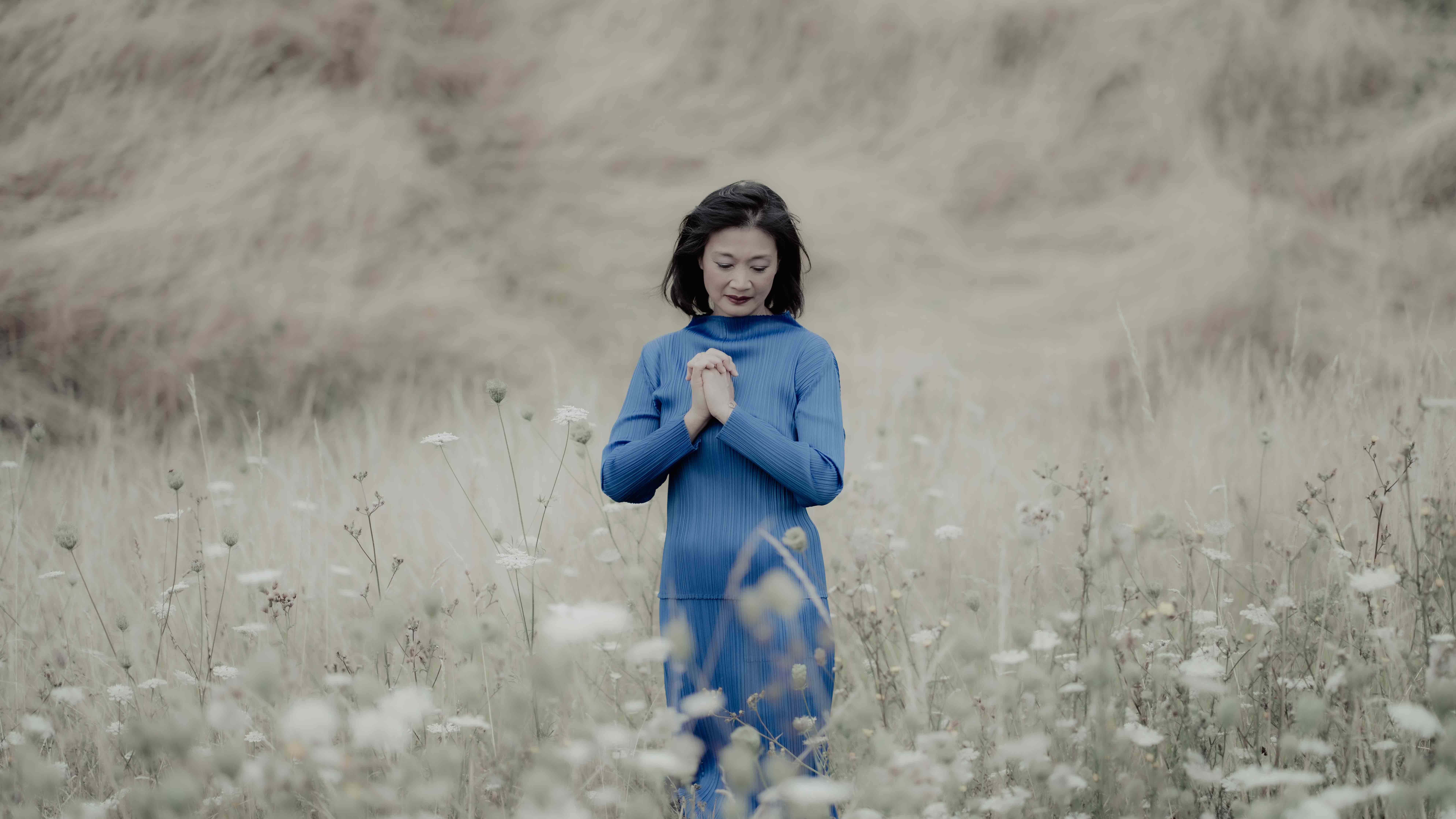
Photo by Lyodoh Kaneko
IDAGIO Meets
 Chloe Weiss
Internationally-acclaimed pianist Mari Kodama talks to IDAGIO about family collaboration, experiences with legendary mentors and insights into her latest album of Bruckner's rarely-heard piano repertoire.
I’d love to start with your musical upbringing, because I read that your mother was a pianist and your father a banker, and that your mother gave up performing to bring you and your sister up on the condition that you played the piano. Is that story true?
Well, it's half true. It's true that she was performing, but then after having children she wanted to concentrate on the family, so she stopped concertising so that she could be with us, but she continued teaching. She had a kind of conservatoire at home with students all day, so I grew up listening to all the students—my baby crib was in the piano room.
What a beautiful story—on one level the sacrifice, but on another level the passing on of her passion to the next generation. Was there ever a sense of pressure or was it a natural progression?
In our home, because there was always someone playing piano – my mother's students – I just assumed that the entire world played piano—that's how it worked. So when I was two I was already sitting on my own at the piano and really wanted to learn. Apparently, according to my mother, I was sitting for two or three hours, sweating to try to make notes, and when I was closer to three years old she said, “Okay, I'm going to teach you how to play and how to read music.” So I started at age three to read music before I started to read books. It was something that was rather natural.
So the musical heritage was there, and you’ve continued that into the next generation of your family, not only partnering with your sister Momo Kodama, but also with your daughter Karin Kei Nagano, who is also a very accomplished pianist. How important was it for you that she learnt music?
I grew up in a musical environment, and Karin Kei spent a lot of her upbringing in opera houses, so she had an even wider musical experience from her birth on. She always loved opera and singing. I believe personally that music can only bring good things into your life. It can bring you more joy during happy times in your life, and it can be a companion when times are not so good. So the idea was that she would have music in her life. There is of course a benefit from only being a passive listener of music—this alone is very good. But if you learn to perform, it's extremely beneficial because you have to think about how to interpret someone who just left notes on the paper. It's a message from the composer and you have to guess what he or she wanted and give your own interpretation, and then use your technique to transmit it to the audience. It's a very interesting procedure that can apply to whatever you do in your life. To do live performance, you have to be aware of the past, the present and the future, because you play according to what you have already played, but you also have to think in advance about what you're going to play. It's a very interesting exercise which can be beneficial to life. So it didn't matter too much if she would become professional or not, but I really wanted her to have this discipline and the chance to be able to explore this path.
I loved your previous release on Pentatone (Mozart & Poulenc Double and Triple Concertos) where the whole family are performing together: mother, sister and daughter on piano, and also your husband, Kent Nagano, conducting. What’s it like working together as a family so closely—it must be a particular kind of bond, musically?
Yes, my husband, sister, daughter and I always make music together in different pairings, but it was the first time we had this combination of all four of us together. We are all very different, but our basic values and aims are the same. Sometimes we just take a different path to get to the result. With family there is no filter in communication, so of course there can be some emotional moments during the rehearsals. The music is not quite flying around, but almost! In the end we always come to the result that we’re all aiming for, so it was really fun to do this project. There is also the absolute trust that on stage – which of course is a different environment with the audience – we can trust each other. If you have an inspiration in the moment and do something different to what we discussed, the other one will catch and feel it at the same time, almost in advance, because we’re family and we can just feel the other person like telepathy. At one concert my sister Momo and I were playing Mozart's double concerto in which the two pianos kind of play the same thing but at different times. At one point I forgot to play my little reply to the other piano, and when it came back the second time Momo just played that part even though it wasn’t her part. This is only possible when it's family—to really feel in advance what the other might do.
What were your biggest early influences as a student, as you were forging your career?
I was very fortunate to have had the most wonderful teachers. Germaine Mounier at the Paris Conservatoire was not so known as a performer, but she was an amazing pianist with an incredible sound. To me, the most important thing from all my teachers is the memory of their sound, their phrasing and their way of breathing. This you can not really learn by reading a book or looking at YouTube. It's the real life experience of a sound. Germaine Mounier was the most direct line from the French composers: Ravel, Debussy, Fauré. I was very lucky to be able to learn the French music from her.
Then there was Tatiana Nikolayeva who was such a great personality and also had an amazing sound. The way she approached the music and the words she used to get right to the point remain the most important things in my memory. Like when you play a piano, it should be love at first sight. That means, don't get into the music after two bars, but from the first note already—there should be love throughout. That still remains for me the most important approach when I play music, even when practising: not a single note should be superficial without putting all your energy and effort into it.
And then of course there was Alfred Brendel. He was such a generous mentor. Because he wasn’t a professional teacher, he really tried to transmit everything that he had accumulated in his musical experience and as an artist. When I went to see Brendel – which was not regularly because normally he was touring for concerts, but twice or three times a year I would visit him for a couple of days – we would have a three-hour lesson in the morning and then in the afternoon he would take me to art museums and exhibitions, not to see classical pieces like da Vinci or Monet, but rather artists that I wasn't familiar with then. After dinner we would listen to CDs and analyse, and talk about literature—why a work is so fantastic. He didn’t just tell me what he thought, but always asked me what I like and why I like it. He taught me that when you play there should always be a balance between your intellect, your heart and your technique, not one more than the other. Also that when you learn a piece, don't just look at the music and analyse. You analyse, of course, but then try to immediately feel the sound of what those black notes on the white paper want to say. For him it was important to put the emotion and the brain immediately to one thing and not to separate them. That still remains for me the most important thing when I approach music.

Obviously Beethoven has been a monumental composer in your career - when did he become central to your output?
We all have to learn Beethoven as pianists, as standard repertoire. I think my first experience with Beethoven was one of those sonatas or sonatinas that my teacher gave me to study at age six or seven, and I immediately felt so connected to him without knowing why. There was something really comforting for me and enlightening. After that I had many French teachers so my repertoire shifted towards French music, and at the conservatoire you learn everything from Bach to contemporary music. At age nineteen I met Brendel, who said, “Try to just learn as much repertoire as possible before you’re thirty, and then decide what you want to do and maybe choose a few composers with whom you can grow all your life.” And obviously Beethoven is a composer with whom you can always discover something new, even after playing for forty years. I was also very fortunate to have had the offer to play all thirty-two Beethoven sonatas in Los Angeles, and it was around that time that my daughter Karin Kei was born and I was reducing my concert activities, so I was able to use that time to learn the sonatas. So it was only Beethoven sonatas for ten years and it was a lot of fun!
Your latest album focuses on Bruckner’s piano music, a lesser-known facet of his repertoire of which there are few recordings available. Can you summarise the music—does it echo his better-known symphonic works and what we know about his quirky character?
Of course we all know the Bruckner symphonies—they're unlike anything else. His personality is all there in the harmonies and the amazing size of the symphonies in depth and length. It’s all extremely large. And of course there is the image that he was not a very easy person, like Beethoven, but I don't necessarily believe what people say about his personality. The reality is not so connected. Because I love Bruckner's symphonies so much, someone said, “Oh but there are also piano pieces. Most of them are not published but they're interesting to look at.” So I looked into them and they are very small, not like the symphonies. Most of them are between two and five minutes, so extremely compact. You'd think that because they’re compact they must be very light, and even if they’re just one page the harmonies are still Bruckner, but it’s very complex and not like anything else. At first sight they look like sketches for study, in the style of Chopin or Bach, but they’re not. You have to really understand what he meant. It was rather challenging because they’re short but concentrated. They’re light, but not so light. You can feel that he really loved some folkloric aspects and joyous things like the Quadrille, Waltz, Polka and Ländler, and all of this brings something very positive. So I'm sure that he also had this lightness and positivity.
With few standard interpretations for reference, which can of course be a good thing, how did you approach the works?
Yes, that's an interesting question. It's true that I first just rely on what I see on the paper, what the composer has left. But after you’ve made up your mind it's always possible with better-known pieces to just cross-check and listen to someone else's recording, to see what someone else is doing. It could be an inspiration or maybe an idea to look at it differently, but normally I already know rather well what I have constructed in my mind. For Bruckner I really didn't have any reference that I could go to because there aren't any major recordings that I know of, so it took much more time to get to where I got to.
This album obviously marks a departure from Beethoven… Will there be more Beethoven in the foreseeable future and are there any other composers you’re particularly keen to explore?
Well the keyboard instruments only have about three and a half centuries of repertoire, but it's quite a lot, actually, and I'm sure that there are many other works that will be discovered that were unknown but still worth discovering. I think it's important to know where we're living today and to know who is making history today for the future, i.e. living composers. It’s always been my interest to know contemporary music and to defend it, so this is in my plan. Beethoven will always be in my repertoire for sure, maybe sometimes seeing it from a different angle. My next concert, for example, is on the pianoforte with a baroque orchestra, so offering a more original way of hearing the Beethoven works. It's also very inspiring when I go back to the big modern instrument to know how Beethoven has imagined and played the music on period instruments. It completely changes the tempo, timing, pedal—everything is different on a period instrument. French music is also always in my blood, so this will always be part of my repertoire as well.
Are there any up-and-coming projects you’re excited about that you can share?
I haven't done so many Lieder projects in the past, but it's something that is a specialisation for me. I think it's a very different way of playing piano, but it could be really amazing and inspiring to work with some great singers. I have a project to work with Julian Prégardien, who I really admire, so we're going to work together very soon. And there's also a French composer that I really believe in called Rodolphe Bruneau-Boulmier. I premiered his Piano Concerto and pieces for solo piano and two pianos, and I'm doing a project with him performing all Beethoven sonatas interwoven with pieces by Bruneau-Boulmier. It offers a different way of listening to Beethoven with this small comment by a contemporary composer.
Bruckner: Piano Works is out on IDAGIO now.