IDAGIO Meets
 Chloe Weiss
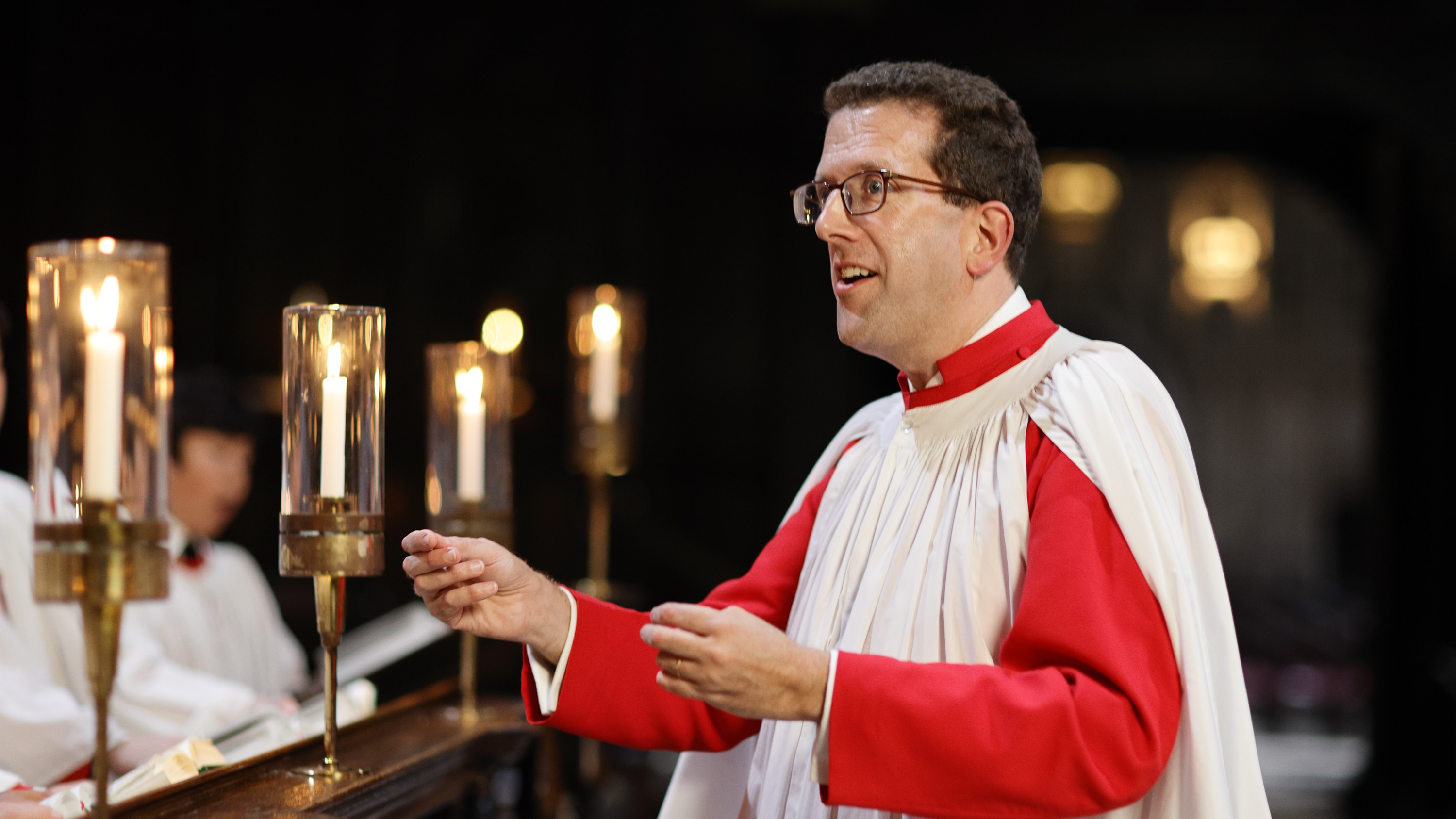
Esteemed conductor and world-class organist Daniel Hyde shares his experiences leading one of the best-known and most-loved choirs in the world, The Choir of King's College, Cambridge.
The Choir of King’s College Cambridge is without doubt one of the world’s most famous and best-loved choirs. How did it feel to be appointed Musical Director back in 2019?
Well it was obviously very flattering, but with it I remember thinking, ‘Wow, okay, this is quite a responsibility,’ for the reasons you mention. We live in an environment now where everybody owns their thing and shouts about themselves online, and that's just not really me. Some people ask me why I don't constantly put myself out there and I think, ‘It's not my choir. It’s King’s College Choir, which has an extraordinary legacy and history, and I'm fortunate enough to be its steward.’ That's kind of how I see myself – it’s very humbling. So when I was appointed, that's what I was trying to think of, rather than flattery, because ultimately I’m putting myself out there to run something which everybody has an opinion on.
Did you know from an early age that this was the career for you?
In my teenage years, I remember going with my mother to drop our German exchange student off at Stansted airport, and she asked, ‘Do you want to visit Cambridge?’ I was a cathedral chorister at Durham and I'd heard of this place, Cambridge, through various comments that my choir master had made – he was actually a King’s organ scholar when he was a student, so this whole idea of King’s and Cambridge was in my head. I remember going to the Chapel on that occasion and walking through the door for the first time. We walked all the way down to the East End to the Rubens painting. I remember that view, looking down, and saying something to my mother like, ‘I’d love to play the organ here,’ and she very quickly snapped, ‘Well you’ll have to do a lot more work then!’ So, I’d watch the Carols from King’s on TV when I was at home and the idea built up in my mind. When I went on to become an organ scholar at Cambridge I certainly thought, ‘Wow, wouldn’t it be amazing to run this,’ but I also believed it was very important to get away from Cambridge if one was going to hope to come back. I suppose I always had a hope that it might happen, but I certainly wasn’t stupid enough to build my thinking around the idea that it would, because it was a hard contest.
Were there any key figures who inspired you to take this career path?
In the early years obviously Stephen Cleobury was a very big part of my formation, and James Lancelot, who was the director of the choir at Durham in my time as a chorister there. I see myself having a huge responsibility to the children I work with now because some of them might come back in the future. That's a big responsibility, to form them and to give them opportunities in the right way. Then I had two very influential organ teachers: Dame Gillian Weir and Nicolas Kynaston, two quite different people who really taught me about music. We just happened to be playing the organ – it was very much that way round. Going forward, Christopher Robinson, who was at St John’s College, and David Hill have been two particular mentors to me. When I was an undergraduate here, I remember asking David for some help when I was going to conduct the college orchestra, but he was busy on another project and it was Stephen Cleobury who said, ‘I think you should go to Christopher Robinson,’ and he arranged that. So I was really fortunate and obviously very aware of how lucky I was to be able to talk to and seek advice from those kinds of people. I believe that every day, as far as I’m concerned, I’m still learning and there are so many things I don’t know I don’t know, even about this job.
The choir has such a busy performance schedule, both at home, throughout the UK and touring internationally, plus a busy recording schedule. It must take some real juggling?
Yes it does, especially now that we live in such a deeply connected world. Even in the last five years, the way we all operate has been forced to change, or develop, whichever way you see it. Some of the things that I end up doing now in terms of management and administration – I think Stephen Cleobury would balk at the idea! But that's now part of the job. Only recently, in the last year or so, have I had the change of mindset where I’ve realised that I will never be on top of everything! There simply aren’t enough hours in the day. So it is a very difficult juggling act, because ultimately you're not going to get any good reviews for your email and everything else you manage on a daily basis.
It’s a very specific role conducting such a prestigious college chapel choir. Do struggles ever arise between academic commitments and musical commitments?
These complications do arise because obviously it involves different people coming through every year. Our interview process is very rigorous, and we try our best to ensure people will thrive in the academic community here and also thrive in the choir. We sing six days a week, we get through a huge amount of repertoire, and you have to be of a certain skill level in order to do that, so it would not be wise for me to lower that expectation. Of course, I also come up against huge misunderstandings as to what excellence is and whether that is in some way elitist, but it’s really about striving for excellence. King’s College Choir is a remarkable thing because it behaves as a professional ensemble, and yet it's made up of these young people who are still being formed in that process. Pastorally, I have to really keep my finger on the pulse as to how people are doing, so we do monitor people's academic achievements and their choral performance very closely.

You cover such a vast amount of music, what’s your process for choosing repertoire?
The choice of what we do is pretty much up to me. In terms of how I choose the music, there is a core repertoire that fits the needs of the Chapel, and I use that as the tools by which I teach. This kind of repertoire might come up every year, either as a set piece for a specific occasion, or because I feel that it is of such a quality that it's a great teaching tool. Alongside this, there are many interesting projects that come along. Every week I get all sorts of packages from composers and people who are sending me their music, so my perusal pile is always straining under the weight of all that paper! It’s important that this depth is considered when choosing repertoire – a breadth and diversity of what that music is. For example, 2025 marks the 400th anniversary of the death of Orlando Gibbons. He was a chorister at King’s, so throughout 2025 we might do a deep dive into pretty much all the Gibbons music and make a study of it. We obviously sing a lot of Gibbons, but the idea of doing it all and actually getting a sense of his vast output could become a special project. So, there are so many different things that go into choosing what the music is going to be, and I can never do all the things I would like to do – there’s just not enough time, believe it or not!
One of the many positives of being a chorister must be acquiring such a vast musical education through the repertoire. Part of the job must also be about really nurturing their musical journey and sparking that passion in them?
I feel that, with children especially, but also with hungry undergraduates, if you give them quality they'll respond to it. It's extremely gratifying, and I take huge pride in seeing the kids respond to what I believe to be really great quality music that they are seeing for the first time. If their responses are great, I feel that means I must be doing something right. Sometimes they’ll get super excited about, I don't know, a piece of Palestrina or Byrd, and you think, ‘but you're an eleven-year-old-kid!’ Last year we did The Dream of Gerontius for BBC Radio 3 with The Bach Choir. The King’s Choir was the semi-chorus and the children were the Choir of Angelicals. They were experiencing music that they would never sing otherwise and you’d hear them walking around humming the tunes. I believe that it’s my job to filter out pure quality and if I put it in front of them, if I raise the bar, they will jump over it.
I wanted to ask about the ongoing debate as to whether girls should have the same opportunities as boys to sing in the choir. Could you tell us a bit about the current situation and what your views are on the topic of girls singing alongside the boys.
Obviously King's College Choir is, through accident of history, all male. The college also has a mixed-voice choir which is similar to the majority of Cambridge college chapel choirs in that it’s a mixture of undergraduates and graduates – not necessarily exclusively of King’s College, but from across the university – and that choir sings on a Monday in the Chapel. My feeling is about creating opportunity, and my own personal view includes not taking away opportunities that already exist. I struggle with the idea of suddenly mixing a choir like King’s because that reduces the number of opportunities – why can’t we look and see what else we can do to enhance our music profile and to enhance the level of opportunity? At the College School now we also have the Schola Cantorum, which is a group of girls who are the same age as the boys singing in King’s Choir, and we changed the school timetable around so that the girls rehearse at the same time as the boys, and that is going well. The Schola is in its infancy, three years now, so still finding what is the right shape and scope that the girls want in terms of its structure, repertoire, when and where they sing, but we're providing the same educational starting point. If I was a parent with a child with musical potential, I think I’d probably have the greatest number of options here at Cambridge than anywhere else in the UK. Pembroke and St Catharine’s run girls’ choirs, and I feel like the ecosystem is really healthy at the moment.
Are there any special projects in the pipeline for you and King’s that you’re particularly excited about?
Next year marks the 80th birthday of John Rutter. King’s and John go back a long way – we recently released a recording of his 2016 work, Visions, and we’ve worked a lot with him in the past – so we may also try to find a way of celebrating him in 2025.
When you became Musical Director of King’s, you joined a long list of legendary figures to have led this iconic choir. What have been your favourite aspects of working with King’s so far and is there a particular legacy that you try to instil?
I think the thing I enjoy the most is the privilege of making music in that building. It sounds terribly cliché, but actually it's a pretty extraordinary studio space to have! Within that comes the real work on the sound of the choir in that building. People talk about “the King’s sound” – I actually believe I have changed the sound of the choir, but that doesn't necessarily mean it doesn't sound like King’s. I think in terms of legacy, I've got quite a few years to go, but were I to move on, if I could leave behind the sort of structure that we've been discussing – the level of excellence, the adaptability to different music, and the ability to perform such a breadth of repertoire – I feel that in itself would be a pretty sizable legacy. I don't see the need for me to leave behind a Daniel Hyde imprint. That’s not what drives me; it’s not my own machine that I’m using for my own self-promotion. But if, at some point in the future, King’s College can operate at an even higher level, and offer people not only an experience which sets them up for if they choose a career in music, but also provides them with skills for life, then I’ll be able to sit at home and smile sweetly.